
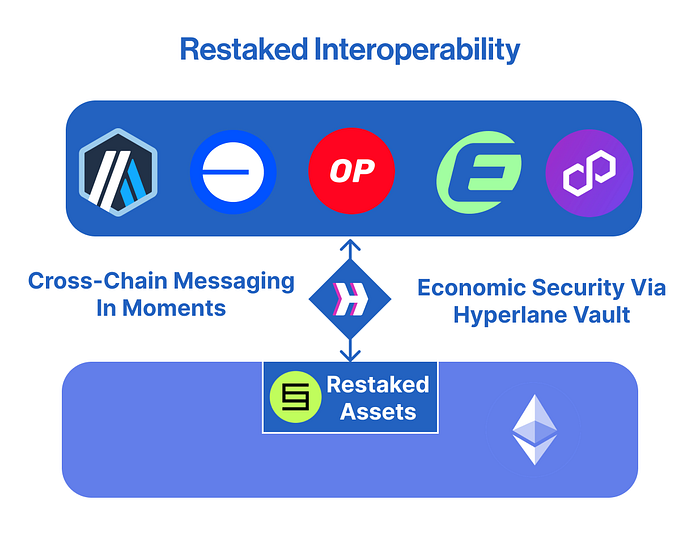
What cross-chain restaking enables
Restaking is a crypto-economic security mechanism that enables staked assets, primarily Ethereum, to be reused to secure additional decentralized protocols known as Actively Validated Services (AVSs) [Chainlink]. While traditional restaking confines this pooled security to the Ethereum ecosystem, cross-chain restaking extends that security model to other networks. This expansion allows validators to back infrastructure on Solana, Layer 2s, and independent L1s using their existing staked ETH, effectively multiplying the utility of their capital.
The mechanism works by locking staked ETH into a restaking protocol, which generates a cryptoeconomic security guarantee. Cross-chain bridges or messaging layers then carry this guarantee to another blockchain. For instance, a validator can secure a new oracle network on Solana without committing new capital, simply by leveraging their existing Ethereum staking position. Projects like Renzo’s Flow Vaults now enable this multi-asset, cross-chain restaking on EigenCloud, allowing any project to tap into this pooled security [Eigenlayer].
This shift transforms ETH from a single-chain settlement asset into a universal security layer. Instead of capital sitting idle in a single chain’s validator set, it flows to wherever the highest yield or security demand exists. This creates a more efficient market for crypto-economic security, where yield opportunities are no longer capped by the capacity of one blockchain’s validator set.
EigenLayer, Allstake, and Renzo compared
Cross-chain restaking has moved from theoretical architecture to deployed infrastructure, but the security models differ significantly. EigenLayer remains the primary source of restaked ETH security, while Allstake and Renzo offer distinct approaches to extending that security or creating new yield vectors across heterogeneous chains.
EigenLayer’s EigenCloud initiative allows projects to rent security from restaked ETH without requiring the underlying asset to leave Ethereum. This model keeps the consensus layer on L1, minimizing bridge risk but limiting native cross-chain composability. Renzo, by contrast, utilizes Liquid Restaking Tokens (LRTs) like ezETH, which can be deployed in DeFi protocols across multiple chains via bridges and intent-based networks. Allstake takes a structural approach, using chain signatures to decouple consensus from execution, enabling restaking across non-EVM chains like Solana and NEAR without wrapping assets into bridged tokens.
The choice between these protocols depends on whether you prioritize native security depth or cross-chain yield flexibility.
| Protocol | Security Model | Supported Chains | Yield Source | Asset Type |
|---|---|---|---|---|
| EigenLayer | Native ETH Security via EigenCloud | Ethereum (L1/L2s) | AVS Fees & Restaking Rewards | Native ETH |
| Renzo | Liquid Restaking Token (LRT) | Multi-chain (via ezETH) | Restaking + DeFi Composability | ezETH (Liquid) |
| Allstake | Chain Signatures (Consensus Decoupling) | Multi-chain (EVM + Solana + NEAR) | Cross-Chain AVS Participation | Native Assets |
EigenLayer’s approach is the most conservative. By keeping restaked assets on Ethereum, it avoids the smart contract risks inherent in cross-chain bridges. However, this limits the yield potential to what Ethereum AVSs can generate. Renzo’s ezETH is designed for maximum liquidity. Because it is a tokenized derivative, it can be used in lending markets and liquidity pools on Arbitrum, Base, and other chains. This creates a yield stack that combines restaking rewards with DeFi trading fees. The tradeoff is increased complexity and exposure to bridge or LRT smart contract vulnerabilities.
Allstake represents a more radical architectural shift. Instead of wrapping assets, it uses cryptographic signatures to prove that an asset is secured by a specific validator set on its native chain. This allows a Solana staker to secure an AVS on Ethereum without moving their SOL. This model preserves the native yield of the original chain while adding a new layer of security revenue. It is particularly attractive for ecosystems that want to participate in the restaking narrative without sacrificing native staking yields.
Yield sources and risk layers
Use this section to make the Cross-Chain Restaking decision easier to compare in real life, not just on paper. Start with the reader's actual constraint, then separate must-have requirements from details that are merely nice to have. A practical choice should survive normal use, maintenance, timing, and budget. If a recommendation only works in an ideal situation, call that out plainly and give the reader a fallback path.
The simplest way to use this section is to write down the must-have criteria first, then compare each option against those criteria before weighing nice-to-have features.
Building a multi-chain restaking portfolio
Use this section to make the Cross-Chain Restaking decision easier to compare in real life, not just on paper. Start with the reader's actual constraint, then separate must-have requirements from details that are merely nice to have. A practical choice should survive normal use, maintenance, timing, and budget. If a recommendation only works in an ideal situation, call that out plainly and give the reader a fallback path.
-
Verify the basicsConfirm the core specs, condition, and fit before comparing extras.
-
Price the downsideLook for the repair, maintenance, or replacement cost that would change the decision.
-
Compare alternativesCheck at least two comparable options before treating one listing as the benchmark.
Restaking and cross-chain protocol FAQs
Restaking is a crypto-economic security mechanism that enables staked assets, such as ETH, to be reused to secure additional decentralized protocols known as Actively Validated Services (AVSs) [src-serp-1]. This approach allows validators to earn yield from multiple services simultaneously without deploying new capital.
Cross-chain protocols solve the fragmentation problem by enabling asset flow across isolated blockchains. For example, the Cross-Chain Transfer Protocol (CCTP) allows USDC to move between chains through native burning and minting, effectively teleporting liquidity without wrapping tokens [src-serp-2]. Recent developments, such as EigenCloud's Flow Vaults, now support multi-asset restaking across these connected networks.
No comments yet. Be the first to share your thoughts!