
What cross-chain restaking actually means
Cross-chain restaking is the practice of reusing staked assets, such as Ethereum, to secure decentralized networks outside of the Ethereum mainnet. It extends the concept of restaking beyond a single chain, allowing validators to provide security to multiple protocols simultaneously through messaging bridges and cross-chain infrastructure.
In standard restaking, staked ETH supports Actively Validated Services (AVSs) built on Ethereum. Cross-chain restaking takes this further by using interoperability protocols to send security commitments to other blockchains. This allows a validator’s stake to back the integrity of a Layer 2, a different L1, or a cross-chain messaging protocol, effectively pooling security across a fragmented landscape.
This mechanism distinguishes itself from single-chain restaking by introducing a layer of cross-chain verification. Instead of just securing Ethereum-based applications, the staked assets help validate transactions or state transitions on external networks. This creates a shared security model where the economic weight of ETH can protect diverse ecosystems, reducing the need for each new chain to bootstrap its own validator set from scratch.
Single-chain versus cross-chain architectures
The core difference between single-chain and cross-chain restaking lies in how security is scoped and delivered. Single-chain models anchor security to one consensus layer, while cross-chain architectures attempt to abstract that security across multiple ecosystems.
Single-chain security: Ethereum and EigenLayer
Single-chain restaking keeps all validation and slashing logic within a single environment. On Ethereum, EigenLayer allows stakers to restake ETH to secure Actively Validated Services (AVSs) without leaving the Ethereum ecosystem. This approach leverages Ethereum’s existing economic security and slashing conditions, which are well-understood and battle-tested.
The primary advantage is simplicity. There are no external bridges to manage, and the risk surface is limited to the Ethereum mainnet and the AVS contracts. However, this model is constrained by Ethereum’s throughput and the availability of ETH. If you want to secure a service on a different chain, single-chain restaking cannot directly provide that security.
Cross-chain security: Extending to Solana, NEAR, and L2s
Cross-chain restaking abstracts security to cover protocols on other networks. Protocols like Renzo’s Flow Vaults and NEAR’s Allstake enable restaking for assets on chains like Solana or NEAR. This allows a project on Solana to benefit from Ethereum’s economic security, or vice versa, by bridging or locking assets across chains.
This approach unlocks new use cases but introduces significant complexity. Security now depends on the integrity of the bridge or cross-chain messaging protocol. If the bridge is compromised, the restaked security may be at risk. The trade-off is broader reach and asset diversity against higher operational risk.
Comparing the models
The table below compares the key differences in security scope, asset types, and bridge dependency.
| Feature | Single-Chain (e.g., EigenLayer) | Cross-Chain (e.g., Flow Vaults, Allstake) |
|---|---|---|
| Security Scope | Limited to one chain (Ethereum) | |
| Security Scope | Abstracted across multiple chains | |
| Asset Types | Primarily ETH and liquid staking tokens | |
| Asset Types | Multi-asset (ETH, SOL, NEAR, etc.) | |
| Bridge Dependency | None (native execution) | |
| Bridge Dependency | High (relies on bridges/messaging) | |
| Slashing Risk | Confined to Ethereum mainnet | |
| Slashing Risk | Distributed across bridge and target chain |
Which architecture fits your needs?
If your priority is maximizing security with minimal complexity, single-chain restaking on Ethereum is the safer choice. It leverages the most robust economic security in crypto without introducing bridge risks. This is ideal for AVSs that can operate within the Ethereum ecosystem.
If you need to secure services on non-Ethereum chains or want to diversify your restaked assets, cross-chain restaking is necessary. However, you must carefully evaluate the trust assumptions of the cross-chain protocol. Look for solutions that minimize bridge dependencies or use zero-knowledge proofs for verification.
Where the yield comes from
Restaking yields are not magic; they are the sum of distinct economic activities. When you restake ETH, you are essentially renting out your validator’s security to Actively Validated Services (AVS). These services—ranging from oracle networks to decentralized sequencers—pay fees to access that security. This is the primary income stream.
Beyond AVS fees, yield often comes from MEV (Maximal Extractable Value). Restaking platforms can bundle your validator’s block production rights with MEV-boost strategies, capturing arbitrage and liquidation opportunities that would otherwise go to standard validators. Additionally, you retain the base staking rewards from Ethereum itself. The total yield is simply AVS fees + MEV + base staking rewards.
The bridge risk premium
Cross-chain restaking introduces a specific risk layer: the bridge. Bridges do not move assets directly; they lock tokens on Chain A and mint wrapped versions on Chain B. This mechanism creates a single point of failure. If the bridge’s smart contract is compromised, the wrapped assets on the destination chain become worthless, regardless of the underlying security of your restaked position.
The risk is not just theoretical. Bridge exploits have drained billions from DeFi. When you restake across chains, you are exposing your capital to both the smart contract risk of the AVS and the custodial risk of the bridge. The yield you earn must be high enough to compensate for this amplified attack surface.
Leading protocols for multi-chain security
Cross-chain restaking moves beyond Ethereum by allowing staked assets to secure networks across different blockchains. This approach decouples consensus from execution, enabling trustless scaling and broader security coverage. Leading protocols like Allstake, Renzo, and Babylon are implementing this through specialized mechanisms such as Chain Signatures and EigenCloud.
Allstake and Chain Signatures
Allstake positions itself as the first meshed restaking protocol, bringing restaking capabilities to all chains. It achieves this by decoupling consensus from execution, a technical separation that enables trustless scaling. The protocol relies on Chain Signatures, a cryptographic method that allows validators to sign messages across different chains without bridging assets. This eliminates the need for traditional bridges, which are often security vulnerabilities, and allows stakers to provide security to multiple networks simultaneously.
Renzo and EigenCloud
Renzo extends the restaking ecosystem through its Flow Vaults, which unlock cross-chain, multi-asset restaking for any project on EigenCloud. By integrating with EigenLayer, Renzo allows users to restake assets like ETH to secure Actively Validated Services (AVSs) on various chains. This model not only generates yield for stakers but also provides a shared security layer for new protocols, reducing the burden of building independent validator sets.
Babylon’s Bitcoin Security
Babylon introduces Bitcoin’s hash power to the proof-of-stake ecosystem. Instead of just securing its own chain, Babylon allows Bitcoin holders to stake their BTC to secure other PoS networks. This creates a new security market where Bitcoin’s immense hash rate can be borrowed by smaller chains, enhancing their resistance to attacks. It represents a shift from isolated security models to a shared, multi-chain security infrastructure.
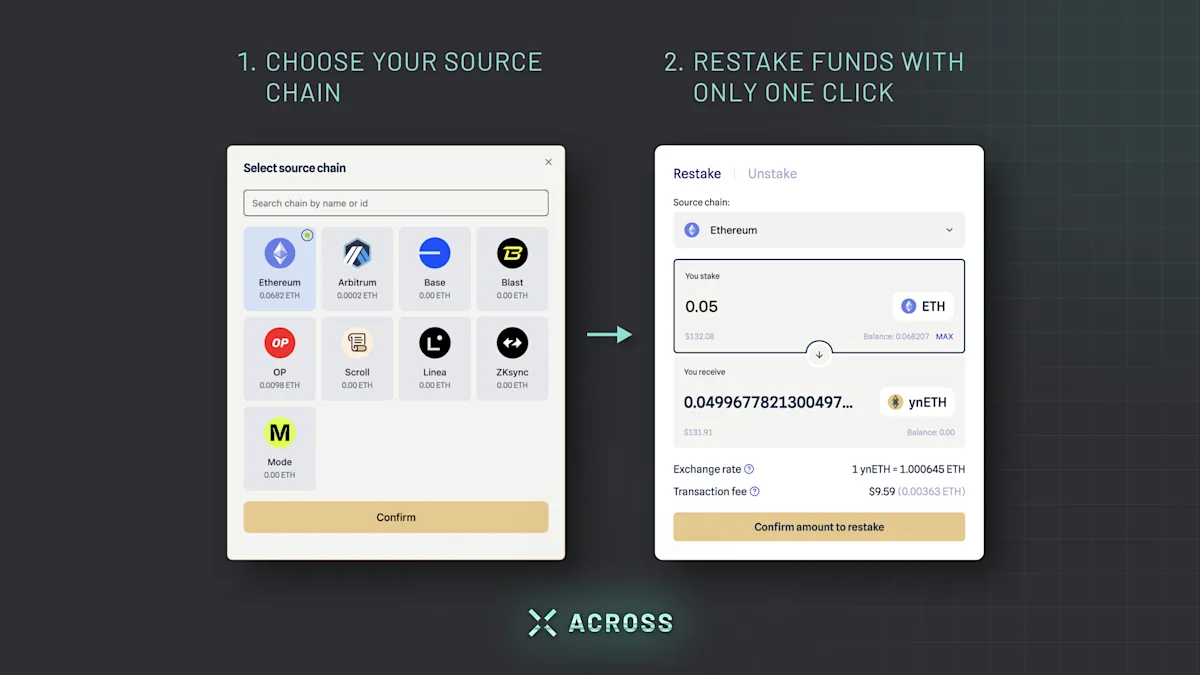
Choosing a restaking strategy for 2026
Restaking is a crypto-economic security mechanism that enables staked assets to be reused to secure additional decentralized protocols, known as Actively Validated Services (AVSs) [Chainlink]. As the ecosystem matures in 2026, the choice is no longer just about yield, but about matching your risk tolerance to the right cross-chain architecture.
1. Evaluate your risk tolerance
If you prioritize capital preservation, stick to single-chain restaking on established networks like Ethereum. This minimizes bridge exposure and simplifies slashing conditions. If you are comfortable with higher complexity for potentially higher yields, cross-chain protocols offer access to diverse AVS ecosystems but introduce bridge and interoperability risks.
2. Check the security model
Not all cross-chain restaking protocols are equal. Look for those using zero-knowledge proofs or threshold signatures to validate state across chains, rather than simple lock-and-mint bridges. Protocols like Renzo’s Flow Vaults or Near’s Allstake are pioneering these trustless scaling methods [Renzo, NEAR]. Always verify if the protocol has undergone formal security audits.
3. Compare yield sources
Yields in cross-chain restaking come from multiple sources: base staking rewards, AVS incentives, and potential MEV capture [Nethermind]. Use a comparison table to evaluate these sources across protocols. Be wary of yields that seem artificially high; they may be unsustainable token emissions rather than genuine security value.
| Strategy | Risk Level | Best For |
|---|---|---|
| Single-Chain | Low | Conservative investors |
| Cross-Chain (ZK) | Medium | Balanced yield seekers |
| Cross-Chain (Bridge) | High | Yield maximizers |
4. Monitor slashing conditions
Slashing is the primary risk in restaking. Ensure you understand how slashing is triggered across chains. Some protocols slash only on the execution chain, while others may slash on the consensus layer. Clear, transparent slashing policies are non-negotiable for long-term security.
Frequently asked questions about restaking
What is the meaning of restaking?
Restaking is a crypto-economic security mechanism that enables staked assets, such as ETH, to be reused to secure additional decentralized protocols known as Actively Validated Services (AVSs). Instead of locking capital once, you can redeploy it to support multiple networks simultaneously, effectively multiplying the utility of your initial stake. This approach allows the same security layer to protect various parts of the blockchain ecosystem without requiring new, independent validator sets.
What is the main benefit for a new protocol to use restaking?
The primary advantage for an AVS is access to established security without the high cost of bootstrapping its own validator network. By tapping into existing staked assets, new protocols can focus their resources on building and marketing their services rather than managing decentralization infrastructure. Meanwhile, stakers benefit from this arrangement by earning additional rewards for providing security to these new services, creating a symbiotic relationship between the two parties.
What is an example of a cross-chain protocol?
Cross-chain protocols facilitate the transfer of assets between different blockchain networks. For instance, the Near Rainbow Bridge allows seamless asset movement between the NEAR Protocol and other chains, while the Avalanche Bridge connects Avalanche and Ethereum. In the context of restaking, protocols like Allstake are emerging to bring restaking capabilities across all chains, decoupling consensus and execution to enable trustless scaling.
No comments yet. Be the first to share your thoughts!