
Secure your assets first
Cross-chain restaking amplifies yield, but it also multiplies attack surfaces. Your capital does not just face smart contract risk; it faces bridge risk. When you restake across chains, you are trusting a bridge to move value and a validator set to secure the destination. If either link fails, the capital is gone.
The KelpDAO and LayerZero exploit on April 18, 2026, illustrates this clearly. Attackers forged a cross-chain message under a 1-of-1 signature scheme, draining 116,500 rsETH worth approximately $292 million. This was not a theoretical vulnerability; it was a successful theft that wiped out 18% of the supply. Such events prove that bridge confidence is fragile and contagion spreads instantly.
Before you deposit, verify the bridge’s security model. Look for multi-sig requirements, threshold signatures, or decentralized validator sets rather than single-signature schemes. Check if the protocol has a history of rapid response to anomalies. Security is not a one-time check; it is a continuous monitoring process.
Thorchain’s recent halt after a $10.8 million drain further underscores the volatility of cross-chain liquidity. When an exploit occurs, trading pauses, and assets may be locked for days. Ensure you have an exit strategy that does not rely solely on the bridge’s uptime. Your security posture must be as robust as your yield expectations.
Choose a bridge paradigm
Your choice of interoperability layer dictates the security envelope of your restaked capital. In 2026, the landscape is divided into two distinct paradigms: Solver-Networked protocols and Bridge-Fed infrastructure. Selecting the wrong model exposes your yield to unnecessary counterparty risk.
Solver-Networked protocols, such as those powered by the Eco network, operate on a settlement layer. They do not lock assets in a bridge contract. Instead, they use cryptographic proofs to verify liquidity across chains. This model minimizes the attack surface, as there is no single point of failure for custodians to exploit. It is the preferred route for high-stakes restaking where capital preservation is paramount.
Bridge-Fed protocols, including traditional wrappers like Wormhole or Stargate, require you to lock assets in a smart contract on the source chain and mint a representation on the destination. While these offer deep liquidity and speed, they introduce bridge-specific risks. If the bridge contract is compromised, your assets are gone. Use this model only when a specific chain lacks native solver support.
| Feature | Solver-Networked | Bridge-Fed |
|---|---|---|
| Security Model | Cryptographic proofs; no asset locking | Smart contract custody; wrapped assets |
| Attack Surface | Minimal (settlement layer only) | High (bridge contracts are frequent targets) |
| Speed | Variable (depends on settlement speed) | Fast (instant mint/burn) |
| Typical Yield | Higher (lower risk premium) | Lower (bridge fees and risk discount) |
| Best For | Long-term restaking positions | Short-term arbitrage or specific chain access |
The data from Eco’s 2026 liquidity report confirms that solver-based models consistently outperform bridge-fed alternatives in security audits due to the absence of locked asset pools. For cross-chain restaking, prioritize the solver model to keep your staked assets off the bridge radar.
Execute the Restaking Flow
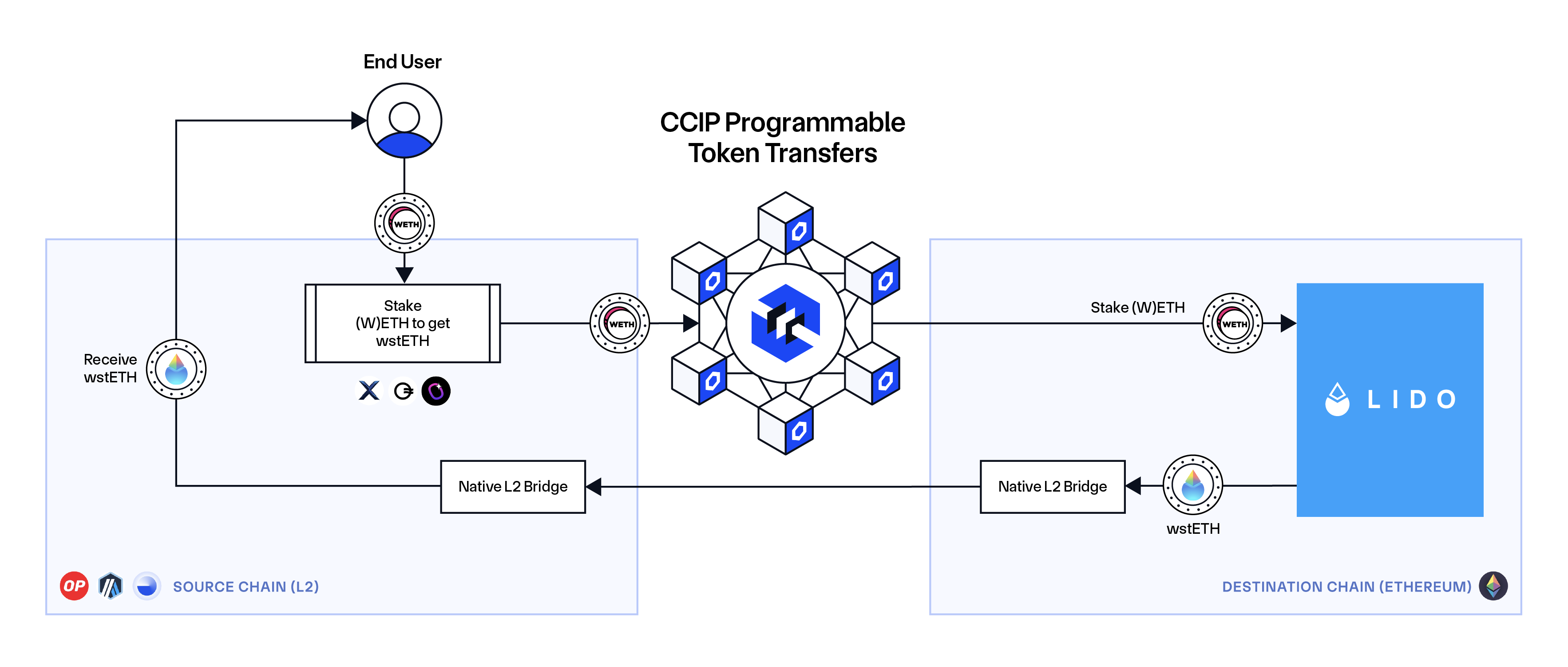
Cross-chain restaking requires a precise sequence: deposit, bridge, and stake. You are moving assets across distinct security domains. A single misstep in the bridge phase exposes capital to smart contract risk or liquidity slippage. Follow this sequence to minimize exposure.
1. Deposit Native Assets
Begin by locking your native assets (ETH, SOL, or native chain tokens) into a Liquid Restaking Token (LRT) protocol on the source chain. This action mints a receipt token representing your staked position. Ensure the LRT protocol is audited and has a proven track record of slashing protection. This step establishes the base yield and security layer before any cross-chain movement occurs.
2. Bridge via Secure Messaging
Transfer the receipt token to the destination chain using a verified cross-chain messaging protocol. Avoid generic, unaudited bridges. Use established infrastructure like Chainlink CCIP or LayerZero, which provide cryptographic proof of transfer. These protocols act as the secure conduit, ensuring the token arrives intact and verifiable on the target chain. This is the highest-risk phase; double-check the destination contract address and network selection.
3. Stake on the Destination Chain
Once the receipt token arrives on the target chain, deposit it into the restaking contract. This contract delegates your staking power to validators or nodes on the new chain. Verify that the destination contract is compatible with your LRT and that the validator set is reputable. Your assets are now actively securing multiple networks simultaneously.
4. Monitor and Manage
Cross-chain restaking is not "set and forget." Monitor slashing events, bridge delays, and yield fluctuations across both chains. Use official dashboards provided by the LRT protocol and the bridge infrastructure. If a bridge experiences congestion, your assets may be temporarily locked. Maintain sufficient gas tokens on both chains for any necessary rebalancing or withdrawal actions.
Monitor yield and risks
Cross-chain restaking introduces layers of complexity that demand continuous oversight. You are no longer just tracking a single protocol’s health; you are monitoring the interplay between liquid restaking tokens (LRTs), underlying validators, and the bridges connecting them. A drop in yield or a spike in gas fees can signal deeper issues in the liquidity pools or bridge solvency.
Start by tracking the performance of your LRTs against their underlying assets. Use a technical chart to visualize price divergence. If your LRT begins trading at a significant discount to the underlying staked asset, it often indicates market fear regarding the bridge or the restaking protocol’s security assumptions. This divergence is your earliest warning sign of instability. Simultaneously, monitor bridge health indicators. Cross-chain bridges are the most frequent target for exploits because they hold large pools of locked assets. Look for anomalies in transaction finality times or unexpected pauses in bridge operations. If a bridge you rely on experiences a delay, assume the worst-case scenario: potential insolvency or a pending exploit. Do not wait for official confirmation to assess your exposure.
Smart contract anomalies can also manifest subtly. Watch for unusual contract interactions or changes in governance parameters that affect yield distribution. If a protocol you are staked with proposes a change to its risk parameters, verify the source and impact immediately. Rely on official announcements from the protocol teams and primary security researchers rather than social media rumors. Early detection allows you to rebalance or exit before losses compound.
Finalize your checklist
Before locking capital into cross-chain restaking, verify every component of your stack. This protocol is not a set-and-forget investment; it is a multi-layered security operation where a single misconfiguration can lead to irreversible loss.
Use this checklist to audit your setup. Each item addresses a specific failure point in the cross-chain bridge or restaking layer.
Treat this verification phase as non-negotiable. The cost of a small test transaction is negligible compared to the risk of bridging significant capital to an unsupported or misconfigured destination.
Common cross-chain: what to check next
Addressing specific mechanics clarifies the operational reality of cross-chain restaking. This section answers precise queries about protocol standards and Ethereum's foundational role.
Work through The to Cross-Chain Restaking
No comments yet. Be the first to share your thoughts!