Bridge assets to the restaking chain
Before you can restake, you must move your assets from their native chain to the target L2 or sidechain where the protocol operates. This transfer is the highest-risk phase of the entire workflow. A single mistake here can result in total loss of capital. We will walk through the exact sequence to move assets securely, prioritizing protocol integrity over speed or convenience.
Deposit ETH into a Restaking Protocol
With bridged ETH secured in your destination wallet, the next phase involves locking those assets into a restaking protocol to generate yield and security points. This step converts idle liquidity into active stake, but it also introduces smart contract risk that does not exist with simple holding.
Before selecting a protocol, review the comparative metrics below to understand the trade-offs between yield potential and chain support.
| Protocol | Est. APY | Supported Chains | Security Model |
|---|---|---|---|
| EigenLayer | Variable (4-8%) | Ethereum Mainnet | Slashing penalties on ETH |
| ether.fi | Variable (3-6%) | Ethereum, Arbitrum, Base | Liquid staking derivative |
| KelpDAO | Variable (5-9%) | Ethereum, Optimism | rsETH yield + restaking points |
Choose Your Protocol
Select a protocol that aligns with your risk tolerance and desired chain exposure. EigenLayer remains the standard for direct Ethereum restaking, offering high security but limited chain diversity. For users seeking exposure to Layer 2 ecosystems, ether.fi and KelpDAO provide liquid staking derivatives (LSDs) that can be further deployed across multiple networks. Note that KelpDAO has faced security incidents in the past; verify current audit statuses and insurance coverage before depositing.
Execute the Deposit
- Connect your wallet to the official protocol interface. Always verify the URL against the project’s official Twitter or Discord to avoid phishing sites.
- Select the ETH asset you wish to restake. Ensure the network matches your bridged ETH location (e.g., if you bridged to Arbitrum, select the Arbitrum pool).
- Enter the deposit amount. Review the gas fees and the expected yield rate. Some protocols require a minimum deposit threshold.
- Confirm the transaction in your wallet. Wait for the blockchain confirmation.
Monitor Your Position
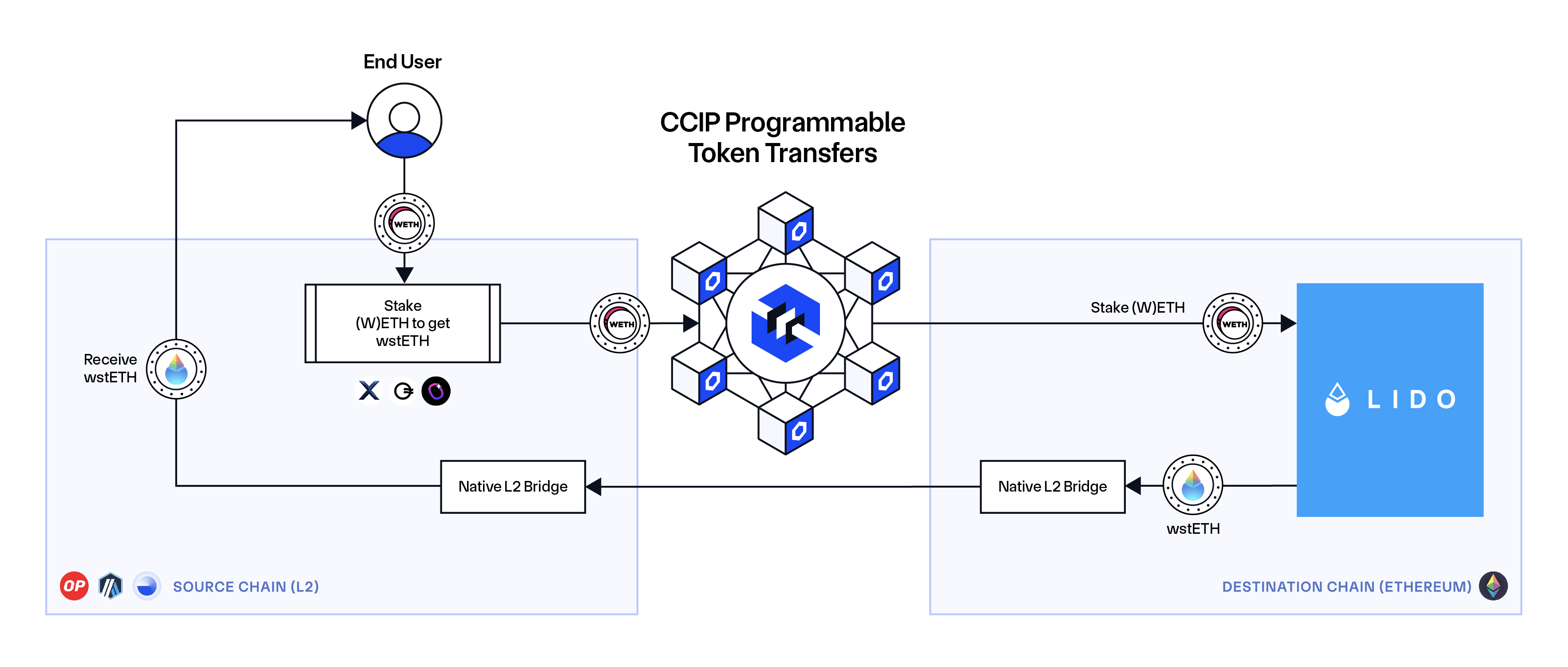
After the transaction confirms, your ETH is now restaked. You will typically receive a liquid staking token (such as rsETH or ezETH) in your wallet, representing your position. Monitor this token’s value and the underlying protocol’s health. Most protocols distribute rewards automatically to your wallet, but some require manual claiming.
Security Checklist
-
Verify the official protocol URL via Twitter/Discord.
-
Confirm the network matches your bridged ETH.
-
Check for recent security audits or exploits.
-
Understand the slashing conditions and lock-up periods.
Configure Delegation to Validators
Delegation is the mechanism that translates your staked ETH into active security for specific Actively Validated Services (AVSs). Unlike standard staking, where you delegate to a generic validator, cross-chain restaking requires you to select specific operators who provide the computational power and security guarantees for the AVS you wish to support. This step determines your yield potential and, more importantly, your exposure to slashing risks.
The process involves choosing between high-yield, high-risk AVSs or conservative, established networks. Because you are effectively insuring multiple protocols simultaneously, a misconfiguration or a poorly chosen operator can lead to simultaneous slashing events across all delegated services. Precision in selection is the only defense against catastrophic loss.
Monitor slashing and bridge risks
Cross-chain restaking amplifies yield but multiplies attack surfaces. Your capital is exposed to two distinct threats: slashing penalties from validator misbehavior and bridge exploits that drain liquidity. Monitoring these risks requires active vigilance, not passive trust.
Cross-chain bridges are high-risk attack vectors. Review the April 2026 KelpDAO exploit for context on bridge security failures. Attackers drained 116,500 rsETH (~$292M) by forging a cross-chain message, highlighting the fragility of LayerZero-based infrastructure.
Track slashing events
Slashing occurs when a validator node violates protocol rules, resulting in the permanent loss of staked assets. In cross-chain environments, this risk is compounded by the complexity of validating across multiple networks.
Set up real-time alerts for slashing events on your primary validator nodes. Use block explorers and protocol-specific dashboards to monitor validator status. If a validator is slashed, your restaked assets may be frozen or reduced immediately. Do not assume insurance or recovery mechanisms are in place; many restaking protocols lack robust slashing protection.
Monitor bridge health
Bridges are the weakest link in cross-chain security. The KelpDAO incident demonstrates how a single compromised bridge can drain millions in minutes. Regularly check the health status of the bridges you use.
Verify the integrity of cross-chain messages before confirming transactions. Look for anomalies in transaction volumes or unusual activity on bridge contracts. If a bridge experiences a delay or fails to finalize transactions, pause your restaking activities immediately. Do not rely on automated bridges for high-value transfers without manual verification.
Respond to security incidents
If you detect a potential exploit or slashing event, act quickly. Disconnect your wallet from the affected protocol and withdraw your assets if possible. Document the incident and report it to the protocol’s security team.
Stay informed about security updates and patches. Follow official announcements from restaking protocols and bridge providers. Do not engage with suspicious messages or links claiming to offer "recovery" or "compensation." These are often secondary scams targeting distressed users.
Verify rewards and withdraw safely
Before moving your assets, you must confirm that the restaking rewards have settled and the withdrawal queue has cleared. In cross-chain restaking, rewards are often distributed asynchronously across different consensus layers. If you attempt to withdraw before the validator’s exit is finalized on the source chain, the transaction will fail or, worse, result in a loss of principal.
Execute the withdrawal in three precise steps:
Always double-check the bridge’s status page before initiating the final transfer. Bridge failures are a common vector for loss, as seen in past exploits where liquidity pools were drained during high-volume transfers. If you are moving significant value, consider splitting the withdrawal into smaller transactions to mitigate risk.
Common questions about cross-chain restaking
Cross-chain restaking introduces complexity that can expose capital to bridge failures or smart contract vulnerabilities. Before deploying assets, verify the security model of every protocol in the path. Use official documentation to confirm how liquidity moves and where the custody risks lie.
No comments yet. Be the first to share your thoughts!