

How cross-chain restaking works
Cross-chain restaking sits at the intersection of liquid restaking protocols like EigenLayer and interoperability networks. It allows validators to reuse their staked assets—typically ETH—to secure multiple services across different blockchains without moving the underlying principal. This mechanism decouples the security layer from the execution layer, enabling assets to generate yield on one chain while providing cryptographic guarantees to another.
Traditional bridging requires locking assets in a contract on the source chain and minting wrapped representations on the destination. Cross-chain restaking avoids this friction by using light clients or messaging protocols to verify proofs of activity. The staker’s capital remains native to the source chain, but their security contribution is verified remotely. This reduces the attack surface associated with bridge exploits while maintaining the liquidity benefits of liquid staking tokens.
The architecture relies on Active Validation Services (AVS) that can verify cross-chain state. When a validator opts into an AVS, they sign off on the security requirements, which are then monitored by the restaking protocol. If the validator behaves maliciously, slashing conditions trigger across the relevant chains. This creates a unified security market where capital is not siloed but shared dynamically.
EigenLayer 2026: The security layer expansion
EigenLayer has evolved from a solo-staking enhancer into the central security hub for the broader crypto ecosystem. By allowing Ethereum stakers to "restake" their assets, the protocol creates a shared security pool that new applications (AVSs) can tap into. This model solves a critical market friction: new protocols no longer need to bootstrap their own expensive validator networks. Instead, they rent security from Ethereum’s existing, deeply liquid stake.
The 2026 strategy centers on breaking the "ETH-only" constraint through EigenCloud. This infrastructure layer enables non-EVM chains to plug into EigenLayer’s security without requiring native Ethereum bridge integration. The result is a multi-asset restaking environment where capital efficiency is maximized across diverse blockchain environments.
This expansion is already visible in production. Projects like Renzo’s Flow Vaults are actively unlocking cross-chain, multi-asset restaking capabilities on EigenCloud. As noted in recent announcements, restaking is no longer confined to Ethereum’s native asset, allowing any project on the network to leverage this shared security model. This shift transforms restaking from a niche yield strategy into a foundational interoperability layer.
The implications for risk are significant. While the security pool grows, the attack surface expands. Stakers are now exposed to the failure modes of multiple AVSs simultaneously. However, the economic incentive remains clear: by securing multiple networks, stakers can capture higher yields than solo staking alone provides, provided they carefully manage their slashing risk across the growing ecosystem.
Leading cross-chain restaking protocols
Cross-chain restaking moves liquid restaking tokens (LRTs) beyond Ethereum mainnet, allowing validators to secure other networks while earning yield. The architecture differs significantly depending on whether the protocol relies on centralized bridges, decentralized message passing, or new signature schemes. Understanding these structural differences is essential for assessing security risks and capital efficiency in 2026.
Allstake: Decoupled Consensus
Allstake utilizes Chain Signatures to decouple consensus from execution, enabling trustless restaking across multiple chains. Instead of relying on traditional bridge mechanics, it uses a distributed network of validators to sign transactions on behalf of the user. This approach minimizes the attack surface associated with centralized custodians, though it introduces complexity in key management and validator coordination. The protocol aims to provide a unified liquidity layer that spans both Ethereum and high-throughput L2s without requiring users to bridge assets manually.
Everclear: L2-First Architecture
Everclear focuses on enabling cross-chain restaking directly from Layer 2 networks, eliminating the need to bridge back to Ethereum mainnet for every transaction. By integrating with the EigenLayer ecosystem, it allows dApps on L2s to access Ethereum’s security guarantees without incurring high gas fees or latency. This architecture is particularly useful for high-frequency applications that require immediate finality. However, it remains tightly coupled to the Ethereum mainnet’s settlement layer, meaning its security still ultimately depends on Ethereum’s consensus.
Chainlink CCIP: Interoperability Infrastructure
Chainlink’s Cross-Chain Interoperability Protocol (CCIP) provides the underlying infrastructure for many cross-chain restaking solutions. It acts as a secure messaging layer that verifies and delivers data and tokens between disconnected blockchains. By using off-chain oracle networks and on-chain verification, CCIP reduces the reliance on trusted third parties. This makes it a preferred choice for protocols prioritizing security over speed, as it can handle complex multi-step transactions across disparate networks with a high degree of certainty.
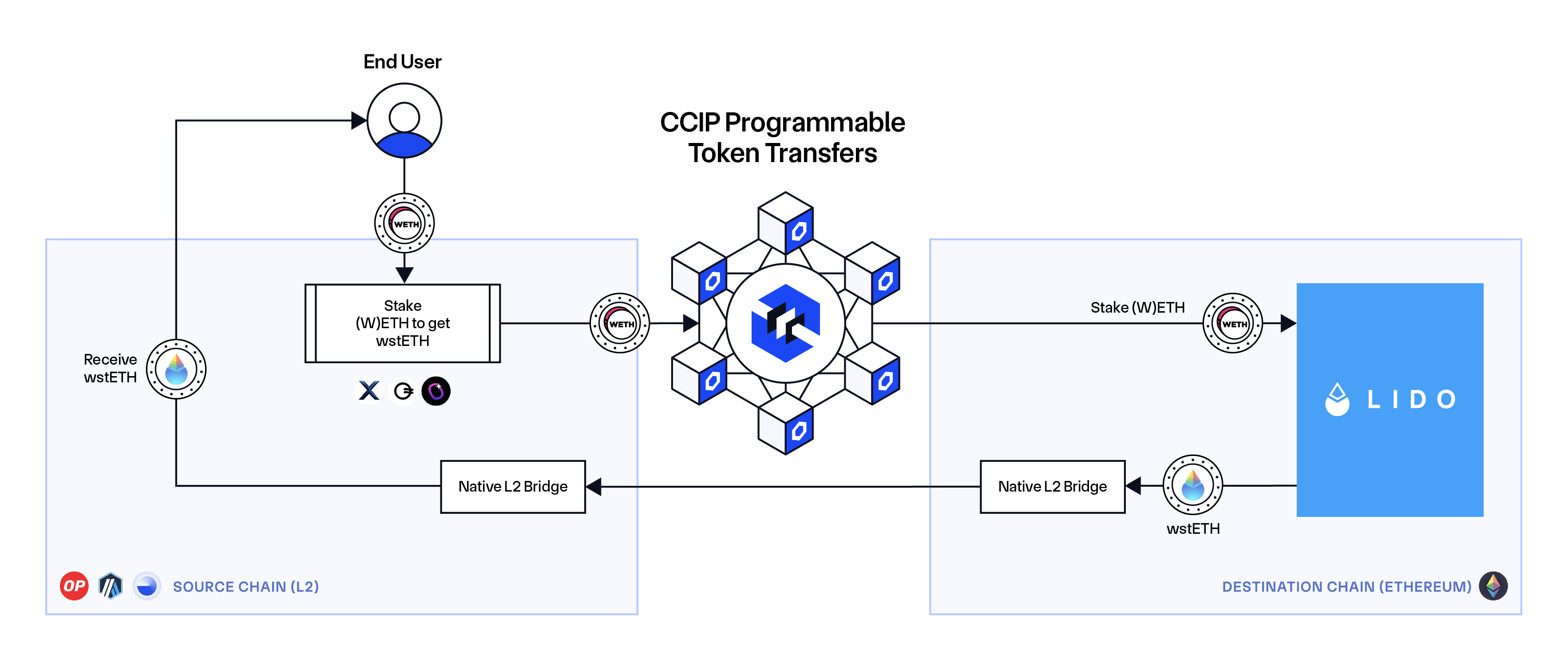
Protocol Comparison
The table below compares the core architectural differences between these leading implementations.
| Protocol | Trust Model | Supported Chains | Asset Type |
|---|---|---|---|
| Allstake | Decentralized Signatures | Multi-chain (Meshed) | LRTs & Native ETH |
| Everclear | EigenLayer Integration | Ethereum + L2s | eigenLRTs |
| Chainlink CCIP | Oracle Network Verification | Any (Interoperable) | Tokens & Data |
Yield strategies and risk assessment
Cross-chain restaking amplifies yield by layering security assets across multiple networks, but it introduces a complex web of dependencies. When you restake ETH on EigenLayer and bridge it to a secondary chain via protocols like Wormhole, you are not just earning staking rewards; you are earning additional yield from Active Validated Services (AVSs) that rely on your shared security.
This multi-layered approach creates a "security multiplier." An AVS can leverage the economic security of Ethereum stakers without building its own validator set, allowing them to offer higher incentives to attract capital. However, this efficiency comes at the cost of increased smart contract complexity. Each bridge and restaking contract adds a potential point of failure, turning a simple yield position into a high-stakes exposure to interoperability risks.
To manage these risks, users must audit the specific AVS and bridge mechanisms involved. The yield is not guaranteed; it is a premium paid for accepting the risk of cross-chain settlement failures. As interoperability protocols mature, the gap between yield and risk may narrow, but for now, higher yields in cross-chain restaking are direct compensation for higher technical exposure.
No comments yet. Be the first to share your thoughts!